

5 Top AI Humanizers and Detectors (2026)
Table of Contents
Let’s be honest, we’ve all been there. You're sitting, staring at a piece of AI-generated text that feels just a little too "perfect" or repetitive to actually sound like us.
As AI writers become a bigger part of how we work, the line between machine efficiency and human creativity is getting blurrier by the day. Still, in many cases, you may find the need to "humanize" AI text from your favorite AI tool.
Whether you’re a creator trying to keep your unique voice intact or an editor tasked with keeping things authentic, knowing which AI-to-human text converters actually work is a total game-changer. We aren't just looking for shortcuts anymore; we’re looking for ways to stay human in a digital world.
1. StealthWriter AI
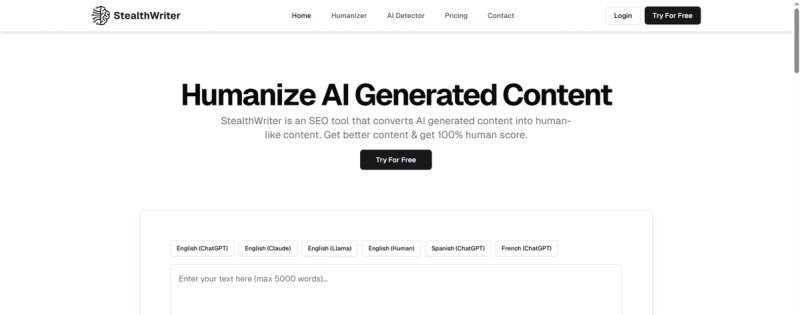
StealthWriter is built for users who need to transform standard AI outputs into something that feels significantly more personal and less "robotic." It works by taking text from models like ChatGPT or Claude and re-engineering the sentence structures and vocabulary to mimic human variance. This is particularly useful for content creators who want to maintain a consistent voice without the rigid, repetitive nature often found in raw AI drafts.
The platform offers different levels of "humanization," allowing you to choose between a light touch-up and a more aggressive rewrite depending on your needs. It is often praised for its speed, though users should always double-check the final output to ensure the original meaning hasn't shifted during the transformation. It bridges the gap between AI efficiency and the nuanced flow of a real writer.
Top Features
- Ghost & Ninja Modes: Two distinct rewriting levels that offer varying degrees of complexity to help bypass different detection strengths.
- Built-in AI Detector: Allows you to check your humanized text against major detection algorithms without leaving the dashboard.
- Sentence-Level Alternatives: Provides multiple options for specific sentences so you can hand-pick the version that sounds most like you.
2. BypassGPT AI
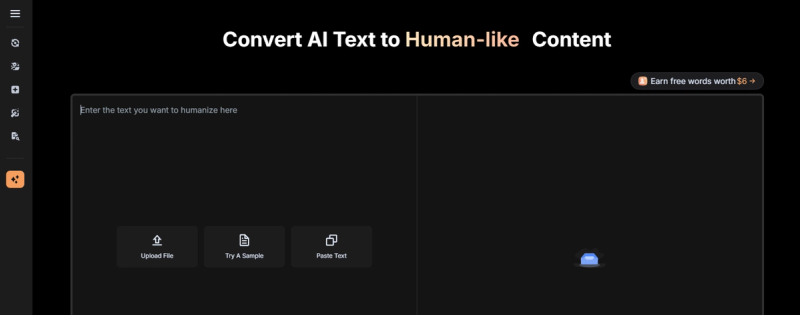
The BypassGPT undetectable AI bypasser positions itself as a specialized "stealth" tool designed to make AI-generated content completely indistinguishable from human writing. It uses advanced algorithms to identify the "tells" of AI, such as overly consistent sentence lengths and predictable word choices, and replaces them with the natural "burstiness" found in human prose. It is a popular choice for marketers and bloggers who want to scale their content without sacrificing SEO quality.
What makes this tool stand out is its commitment to maintaining the original context of your writing. Unlike some rewriters that produce garbled text, BypassGPT focuses on readability and grammatical correctness. It is designed to handle a wide range of content types, from academic-style essays to casual marketing copy, making it a versatile addition to any digital toolkit.
Top Features
- Watermark Removal: Specifically targets and removes the subtle digital footprints often left by models like ChatGPT.
- Multilingual Support: Capable of humanizing text in over 50 different languages, making it a great asset for global content teams.
- SEO Optimization: Integrates keywords naturally into the rewritten text to ensure the content remains high-ranking and searchable.
3. Uncheck AI
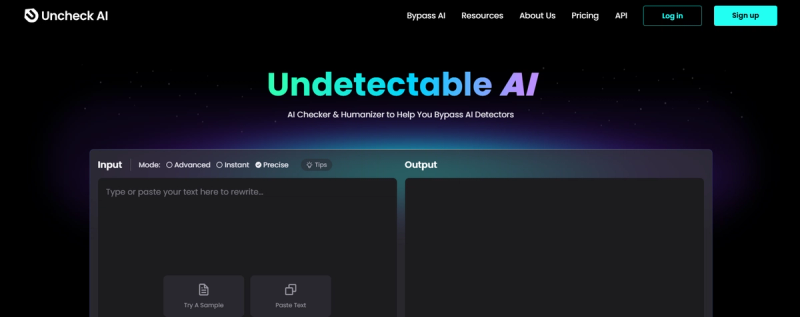
Uncheck.ai is a streamlined, user-friendly, undetectable AI platform that focuses on making AI text "invisible" to detection software. It operates on the principle that AI detectors look for mathematical patterns; by breaking those patterns, Uncheck.ai helps your content pass through as human-written. It is often used by freelancers and students who need a quick, reliable way to polish their drafts and ensure they don't trigger false positives on integrity checks.
The tool is remarkably simple to use, featuring a "paste and click" interface that delivers results in seconds. While it is highly effective for shorter pieces of content, it also offers enough depth to handle long-form articles. Its primary goal is to provide peace of mind by ensuring your work sounds authentic and flows logically from one paragraph to the next.
Top Features
- Multiple Bypass Modes: Offers a variety of settings (like "Standard" or "Advanced") to tailor the level of rewriting to the specific detector you are trying to clear.
- Grammar Integrity: Prioritizes error-free output so you don't have to spend extra time fixing typos or awkward syntax after the humanization process.
- Original Meaning Retention: Uses smart context-mapping to ensure that the core message of your text stays the same, even after heavy editing.
4. ZeroGPT
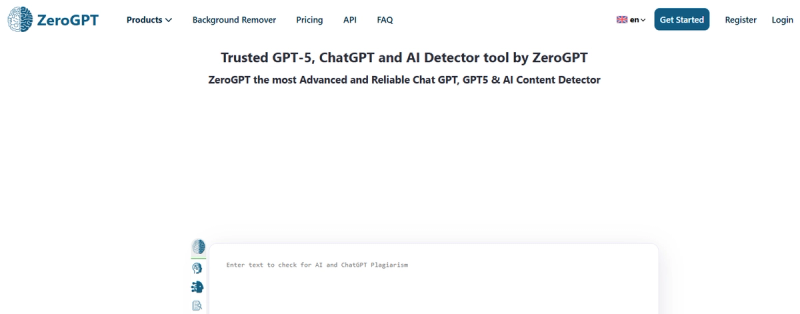
ZeroGPT is one of the most widely recognized names in the world of AI detection. Rather than humanizing text, this tool acts as a scanner, providing a detailed breakdown of how likely it is that a piece of writing was generated by a machine. It is the "go-to" for many educators, editors, and publishers who need to verify the authenticity of a submission. It uses a "DeepAnalyse" technology that looks at the structural DNA of the text.
When you run a scan, ZeroGPT provides a percentage score and highlights specific sentences that it flags as suspicious. This transparency is helpful because it allows writers to see exactly which parts of their work might be coming across as too formulaic. While no detector is 100% perfect, ZeroGPT is known for its high sensitivity and is frequently updated to keep pace with the latest AI models.
Top Features
- Sentence-Level Highlighting: Clearly marks which parts of a document appear to be AI-generated versus those that seem human-written.
- Batch File Uploads: Supports scanning multiple documents at once, which is a massive time-saver for teachers or content managers.
- PDF Reports: Generates professional, downloadable reports that can be used as proof of originality or for editorial feedback.
5. WriteHuman
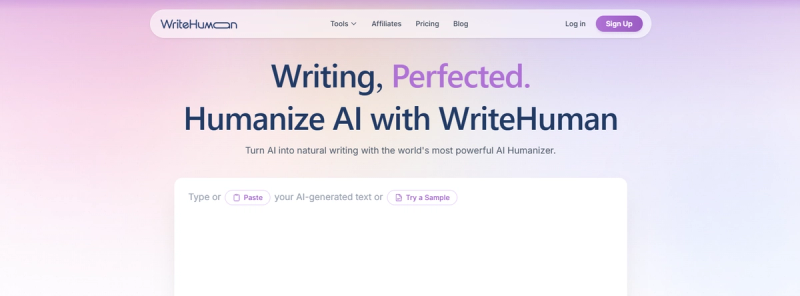
WriteHuman is a premium humanizer that prides itself on creating high-quality, polished content that feels like it was written by a professional. It goes beyond simple word swapping by restructuring thoughts to sound more persuasive and engaging. It is geared toward professionals who need their AI-assisted work to be "bulletproof" against detection while also being genuinely pleasant for a human to read.
The platform is designed with privacy in mind, ensuring that your data isn't used to train further models. It offers a very high success rate in bypassing advanced detectors like Turnitin and Originality.ai. If you are looking for a tool that treats your writing with a level of care that feels more like an editor than a machine, WriteHuman is a strong contender.
Top Features
- Enhanced Logic Model: Uses a more sophisticated reasoning engine than standard rewriters to ensure the "flow" of ideas is logical and mature.
- Free Retry Policy: If your humanized output is still flagged by a detector, the platform often allows you to re-run the process at no extra cost to get a better result.
- Privacy Protection: Ensures that all submitted content is handled securely and is never stored or used to train other AI systems.
Does Using AI Humanizers and Detectors Impact Your SEO?
A common question for anyone using tools like StealthWriter or WriteHuman is whether "hiding" AI-generated text is actually necessary for ranking on Google. According to Google’s latest Search Essentials, the algorithm focuses on E-E-A-T (Experience, Expertise, Authoritativeness, and Trustworthiness) rather than the specific method of production.
However, there is a catch: raw AI content can trigger "Helpful Content" filters because it lacks the unique sentence variance and personal insight that human writers naturally provide.
Using a humanizer isn't about "tricking" a search engine; it's about improving the user experience by making the text more readable and engaging. By running your drafts through a humanizing tool, you are essentially performing a quality control check.
This ensures your content doesn't fall into the "robotic" patterns, like repetitive sentence lengths and predictable word choices, that Google often associates with low-effort, automated spam. When used correctly, these tools help you maintain a high standard of quality that satisfies both algorithmic checks and real human readers.
For better search engine visibility, we recommend using specialized AI SEO tools instead. They can help you analyze keywords, find content gaps, spot new internal linking opportunities, and more ideas that actually help you rank.
Is it Ethical for Students to Use AI Humanizers and Detectors?
The academic world is currently in a state of flux as it tries to figure out where AI fits into the classroom. For many students, AI humanizers are tempting shortcuts to avoid being flagged by strict institutional detectors like Turnitin. However, the conversation is shifting from "how to hide AI" to "how to use AI as a collaborator."
These humanizers can be used as learning assistants to help a student refine their phrasing and make their writing flow better. But they shouldn't be used to replace the actual research and critical thinking that an assignment requires.
Most universities are now focusing on "AI literacy," which means they expect students to be transparent about their process. If a student uses a detector to check their own work, it can actually be a great way to identify where their writing sounds too "textbook" and where they need to inject more of their own voice.
The danger lies in relying entirely on the machine. If the tool changes the meaning of your thesis or introduces factual errors, the "humanized" version won't save your grade.
If you are a student, we think the best way to look at these tools is as a high-tech "polishing" phase rather than a "writing" phase. There is a huge difference between using StealthWriter to fix a clunky paragraph you wrote yourself and using it to mask a 2,000-word essay that you didn't even read.
In our opinion, the most successful students in this age of AI will be the ones who treat AI like a sophisticated thesaurus. Use it to find better ways to express your ideas, but keep your hands on the steering wheel.
Conclusion
At the end of the day, these tools are exactly that—tools. They can help us polish our ideas or double-check our work, but they can’t replace the lived experience and personality that a real person brings to the page.
Whether you are using a humanizer like StealthWriter to loosen up a stiff draft or a detector like ZeroGPT to keep things transparent, the goal is always the same: better communication. As the tech keeps evolving, the best approach is to stay curious, keep testing these platforms, and always give your final draft that last "human" read-through before it goes live.